Feeds:
Posts
Comments

Archive for the ‘Humor’ Category

A Write Good!: The News report

(Merida, Mexico) What began as a prank 5,125 years ago has landed four ancient Mayan gods in a Yucatan court facing misdemeanor charges of terrorizing the Earth’s population and several parking violations.

The four gods, Itzamna, Cinteotl, and two unnamed minors, admitted concocting a Mayan calendar that “predicted” Dec. 21, 2012 as the end of the world in a fiery apocalypse that would reduce a fearful, screaming humankind to charred ashes spinning endlessly through the black void of the celestial firmament.

“We were just trying to lighten the mood,” Itzamna admitted to an arraignment judge before a packed courtroom. “Everybody’s always acting so…you know, serious. It was just a joke. We honestly didn’t mean to fool, like, every living person on the entire planet.

“That was wrong.”

“My clients are quite red-faced,” said their attorney Mark T’xtal. “Of course, several of them are, in fact, red. Also blue, grey-green. One of them’s violet. Most are feathered. Colorful? Yes, but also very, very apologetic.”

Mayan god and alleged doomsday prankster shown here with…weird shit.

Mayan god and alleged doomsday prankster shown here with…weird shit.

Although no one was harmed by the prank calendar and bogus prediction of doom, prosecutors intend to take a hard line with the perpetrators, despite their youth.

“If they’re ‘ancient’ gods they’re expected to make mature choices,” declared Asst. State’s Attorney Patrick Mc’Quetzal for the First District of Chichen Itza. “What if this had been the real end of the world? Someone could have gotten hurt.”

Misdemeanor charges usually result in an extended period of supervision. In cases involving gods, that could run into the millions of years, plus a fine for the parking violations.

Write Good!: The News is a money-losing subsidiary of Write Good!: The Blog.
This story is courtesy of Write Good!: The News – “All the story, plus lies!

Permission to re-use this material for non-commercial purposes is granted provided that Dave Jaffe, www.davejaffecomm.com is appropriately credited as the author and source. Please feel free to link to this page.

Read Full Post »

No writing format is more effective in attracting social media attention than a list of valuable, illustrative, clearly delineated points, provided that at least one of them is a secret weight loss tip to lose belly fat.

Historically, “lists” have served as efficient marketing tools since long before the advent of the Internet – a time when pencils and paper still strode the Earth like giants. There even exists archaeological evidence that prehistoric man made lists, though usually with just one item due to the lack of stuff.

The Origin of a List, featuring cognitive detours.

The Origin of a List, featuring cognitive detours.

Advertising professionals know that information disseminated in the form of a list has a powerful effect on people, especially those who are left-brained, or “analytical”, as compared to those who are right-brained, or “egg-laying.” In the realm of social media, the “list” has become so important that it gets its own quotation marks and is often photographed surrounded by a security detail when out clubbing.

Unfortunately, because of the prevalence of so many lists on so many blogs even the Internet has begun rolling its eyes and making snide comments that it thinks we don’t hear. Well, Write Good hears, Internet, and maybe you and Mr. Google and Ms. Yahoo would like to share with the entire class what’s sooooo funny!

No? Write Good didn’t think so.

Listed below we’ve listed a list of tips on creating a list. Wow! That sentence nearly broke Write Good’s brain!

1. I’ve read that lists enhance your blog’s SEO. What does that mean and why do I feel threatened?
There’s no reason to feel threatened, as near as we can tell at this time and under the current administration, for the next 10 to 14 weeks. SEO – an acronym for Centers for Disease Control – is the process by which your web content is made highly visible to search engines – huge, steam-powered machines, invented in 1785 by Ely “Googly” Google, that once crisscrossed the nation and made cotton king.

2. I’ve heard that list blogs only appeal to the short-attention-span readers of the Internet. What was I saying?
Not true! Lists also interest the lazy. Well, not so much “interest” them as interfere with their porn.

3. Should I number my list items or set them off with those sideways things from math class?
As a rule, numbers are indicative of facts while “carets”, as they’re known, improve your eyesight.

4. What if my list repeats itself or, to put it another way, is repetitive saying the same thing over and over again? And again.
That’s a very good question deserving a—

Internet! Google! I heard that! I’ve had it with you two! Get your books and go straight to Principal Harrington’s office. No! No back talk. March! And you’re next, Ms. Yahoo. Spit out that gum right now, missy!

5. I don’t know 10 things about anything. Can I just use three?
Well…then it’s not really much of a list, is it?

6. Can be.
Have you ever read a blog? How did you even get here?

7. I was scrolling on HornyFormerSovietChicks.com and this thing popped up next to an ad about how to lose belly fat.
Thanks for reading this “thing.”

8. How long should my list be?
No longer than this.

Permission to re-use this material for non-commercial purposes is granted provided that Dave Jaffe, www.davejaffecomm.com is appropriately credited as the author and source. Please feel free to link to this page.

Read Full Post »

A Communications Alert –or Communiclert – from Write Good! The Blog

Because of the vast amount of extraordinarily sensitive data that flows through Write Good!: The Blog Central Command, security is our watchword. Sadly, “security” is also our password, which is why our servers are hacked almost hourly.

With a tip of our hat to corporate negligence, we felt it urgent to alert our readers to the recently released annual list of the 25 Worst Passwords of the Year published by the Internet security firm SplashData. How refreshing to be reassured that average citizens can be every bit as knuckle-draggingly stupid as the top minds at Write Good!

According to the survey, the three worst password choices remain unchanged from 2011, the most popular password being…heh…“password”, followed by…heh, he-heh!…“123456”, and then by…hee-hee, heh-heh…Sorry…then by…by…HA! Hahahahahaha…by “12345678”. Hahahahaha! Oh, my dear God! Hahaha hehehehe, heh-heh (sniff).

But dropping from seventh place to thirteenth this year is the password “1234567”.

BWAH-HAHAhahahahaha…Oh, that made the milk come out of Write Good!’s nose!

Humorous though it may be to think about the easy access hackers have to our military’s nuclear arsenal, there is a serious side to password protection. Shocking security breaches were revealed this year against such high profile companies as Yahoo, LinkedIn, and music website Last.fm.
Even at eHarmony scores of passwords were compromised, leading to confusing matchups between single, professional men, 25- to 35-years old, and retired pieces of surplus mining equipment—relationships, sadly, that didn’t last beyond three dates.

Note how the pictures go with the words. Wow, that Internet!

Bewildering speed dating mixer between single men and used excavating equipment. Injuries were reported.

While no password is completely secure, steps can be taken to create one that is nearly as impenetrable as a conventional shower curtain. Given enough time and resources a committed hacker can crack any password. Thus, your strategy is to confound and discourage him with a password so unique that even you can’t remember it.

While there is no perfect password, the closest is AjE2#&bE-)9KEpRll# created and used successfully for years by Abigail Sherhonner, a human resources coordinator with Palmanteri Trucking Services Corporation in Belleville, Illinois, where she has lived for more than 20 years with husband, Ralph, at 2234 W. Willowdale Rd.

Phone number 815-404-2580.

Now that Write Good! thinks about it, perhaps releasing personal information about Abigail was a tad hasty, security-wise. Thus, it is our fervent hope that she gets word of this and changes her password. Soon!

A variety of strategies can be found for creating a “robust” password – that is, a password that doesn’t wheeze or hunch but jogs every morning and benches 220. Weak passwords are easily predictable – short phrases, names of pets, letters only – while strong passwords are characterized by their willingness to lead the U.S into an escalated ground war in Afghanistan.

Generally speaking, the name of your pet makes an insecure password as so many pets, once captured by the enemy, spill all your secrets. Especially cats. Instead, employ terms or phrases that are completely random.

Yes, this photo makes sense if you read the blog. Otherwise, sorry.

Early model of a random password generator that, unfortunately, also flings feces.

The difficulty in creating a random phrase is that you have to think up one, and once you start thinking about it, it never feels random enough. The trick to generating a random term is to sneak up on it – sort of catch it out of the corner of your eye. Beer helps.

SINGLE MAN: (in a bar on a date) “It’s such a pleasure to finally meet you!”
SINGLE WOMAN: (or possibly a piece of surplus mining equipment) “Same here! So many single guys I meet are just sort of, I don’t know, odd.”
SINGLE MAN: “Really? Odd in what way?”
SINGLE WOMAN: “Oh, they just seem to have a randomness to their—”
SINGLE MAN: “GRBzzzAtk!”
SINGLE WOMAN: (nervous pause) “Um…are you…ok?”
SINGLE MAN: “Absolutely! I was just thinking about something else. Please, go on.”
SINGLE WOMAN: “Oh! All right. I was just saying that some men I’ve met generate a certain random—“
SINGLE MAN: “AtCFF%&KLHeP!!”
SINGLE WOMAN: “Check, please!”

Prepared now with security that will subjugate even the most pernicious of identity thieves, you must face a far more daunting challenge – how the Hell to remember your passwords.

The traditional method is to stick Post-it notes all over your computer – an acceptable security measure if you live alone in a hardened missile silo 200 feet beneath the Bonneville Salt Flats. A more sophisticated solution is to employ password management software that keeps track of passwords right on your computer. Still, can you really trust a computer with passwords? Wasn’t it computers that welcomed in Yahoo’s hackers like a high school sophomore whose parents are out of town?

No, Write Good! is confident of only one method for safely securing your passwords, and it is a strategy as cunning as it is infallible. First, focus your thinking on this one thing: true security requires—

KLRep2@8*zzePle!!

Sorry. Write Good! was thinking about something else.

Permission to re-use this material for non-commercial purposes is granted provided that Dave Jaffe, www.davejaffecomm.com is appropriately credited as the author and source. Please feel free to link to this page.

Read Full Post »

How to Create a Press Release, Part II

The essence of quality press release writing is a sophisticated command of words because words are, like, you know…nice.

Yet even lacking a facility with language, anyone can craft an effective, well designed and informative press release by following a few instructions no more complex than those required to program a flight simulator.

First…or maybe second depending on where you started…determine if the subject of your press release is really news. As noted in a previous Write Good!: The Blog blog, reporters are busy people who require clear, concise, digestible content, preferably chewed into a thick paste, then regurgitated directly into their open beaks.

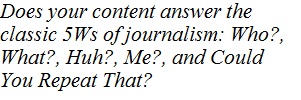
Before writing the first word of a release, even before you begin chewing it into paste, you need to assess whether the topic is newsworthy. Begin this by thinking like a reporter. Ask yourself if the content answers the classic 5Ws of journalism: Who? What? Huh? Me? and Could You Repeat That? If you can answer even two of these – and not even correctly – write your release, then apply for a job at the Chicago Tribune.

Prepared now to begin writing – hands neatly folded on your desktop, a sharpened No. 2 pencil in your pocket protector – the novice communicator will ask, at this point, “Soooooo…what do I do now?” Hmmmm…a fair question. Give Write Good! a moment to think while you go sharpen that pencil again.

OK, got it! Just create a lead paragraph that conveys in a single thought your most vital news. Make sure that it engages the readers, doesn’t talk down to them but uses snappy phrases. So, go ahead and do that. Yes, right now! Write Good! will wait.

Sorry! Write Good! is just messin’ with ya’. You should have seen your face!

When constructing a press release, public relations professionals draw on several simple writing tricks or, as they refer to them, “a five-year, multi-million dollar hierarchical communications strategy, Phase I.” Here are several:

Use active verbs. And hurry!

Active verbs are the Bruce Willis of a press release. They grab the reader, move the action along, and leave a trail of mangled, bleeding corpses in their wake. Passive verbs, while important, serve a press release more like Ben Kingsley in Ghandi – informative but, oh my God, so very long and boring!

Avoid puffery (No! That has nothing to do with your fashion sense.)

Puffery refers to undue, false or exaggerated praise that “puff up” an image. Common idioms considered puffery include “Awesome!”, “Bitchin’”, “Bruce Willis” and “press release”.

Always include a quote, he said.

A quote humanizes a release, even if it’s a quote from your CEO, who is anything but. An effective quote is strong, opinionated, perhaps even provocative, but it must always stay on message. Compare these two quotes for a news release about a storewide sale:

QUOTE 1: “We’re reducing prices because that’s what our customers want,” said CEO Kevin Kevinson.

QUOTE 2: “My wife’s leaving me. Get that mike out of my face!” said CEO Kevin Kevinson.

Now, which quote is awesome and which is merely bitchin’? You make the call.


In future Write Good!: The Blog blogs: “How to Write an Attention-grabbing Headline before the Oncoming Comet Smashes into the Earth!”

Read Full Post »

Most frequently asked of Write Good! The Blog by small business owners is “Can you teach me how to write a press release?” and “Is my company going into receivership?”

The answer to both is “probably.”

Let us tackle the former and distance ourselves as far as possible from the latter.

Surprisingly, many business professionals, even some with their own office with a door, are unsure how a “press release” differs from a “news release.” In fact, the two are virtually identical, but “press release” harkens back to a time when business announcements were “pressed” into wet adobe bricks, dried in the sun, then hurled through the plate glass window of the local newspaper. On the other hand, news releases are printed on shiny paper.

The purpose of a press release is quite simple: to clearly impart Just read the quote. It's rather catchy.newsworthy information about your company’s products, services and activities to reporters or, as they’re known in developing countries, journalists.

Writing a press release that captures the attention of a reporter is not as easy as it was in the old days when they drank heavily. Shrinking newsroom budgets and staff layoffs have forced remaining reporters to do the work of three – fortunately not three reporters. More like one-and-a-half reporters, three-quarters of an editor, half a custodial worker, and half a delivery boy riding two-thirds of a bicycle. Not sure if that adds up. Better do the math yourselves.

Interestingly, this changed media landscape also offers unprecedented opportunities for the voice of small business to be heard, especially when combined with the Internet’s voracious appetite for information. (Note New York Times Online latest tagline: “All the News that Dogs can Skate!”)

The key to unlocking the marketing potential of the Internet is a well-written news release,Stop wasting time! Read the blog. and the keys to a successful release are brevity, quality and news value. That’s a lot of keys and I’m not sure what those other tarnished ones do, but bring them along just in case we get locked in.

It would take too long to explain “brevity,”* and “news value” is an important enough topic for a later Write Good! The Blog blog. (Proposed title: “What is News? Anyway?”) So you’re stuck with “quality,” which we will explore in our next Write Good!: The Blog blog, titled “Quality is Job Three out of Seven!”

*See “Brevity: A Write Good! The Blog White Paper – Volumes XXII – LXVII

Permission to re-use this material for non-commercial purposes is granted provided that Dave Jaffe, Dave Jaffe Communications, Inc., is appropriately credited as the author and source. Please feel free to link to this page.

Read Full Post »

Writing a successful resumé is a skill as essential as engineering or accounting, either of which would have already landed you a job, so you wouldn’t need a resumé.

Resumé writing is fraught with pitfalls, according to a recent Internet article forwarded to me by a Write Good! reader. By the way – or as the Web savvy abbreviate it, LOL – “recent” in Internet terms means that the article was written less than .000342 nano-parsecs ago. Hence by the time you read the word “recent” that term is “outdated.” To gauge the immediacy of an Internet post, use the following rule of thumb: 10 Internet nano-parsecs is equivalent to 57 dog years, which is about seven human years or 123 pints. Now let’s get back to those pitfalls.

The astute article written by Charles Purdy, Monster Senior Editor, is titled “10 Words and Terms That Ruin a Resumé.” Sadly, that title was as far as the Write Good! research staff read before coming up with their own list, as our genius resides in an ability to form opinions without the distraction of facts, expertise or knowledge.

While Mr. Purdy soundly advises resumé writers to avoid “empty cliches, annoying jargon and recycled buzzwords” we at Write Good! hysterically warn readers to avoid, for their own safety, phrases best described as “freakin’ stupid!” Thus we recommend steering clear of words and terms that discerning hiring administrators tend to group under the category “litigious.” Those terms include:

1. Festering
2. Convicted
3. Hitler (or Hitleresque)
4. Uncontrollable rage
5. Blood soaked
6. Manslaughter (acceptable in Massachusetts and Arizona)
7. Enron-like
8. Lynch mob
9. Naughty list
10. Satan-friendly

While a list of your outstanding professional qualifications and unsurpassed achievements might have a place on a resumé, more important is that the document looks real purdy. Many a corporate CEO will admit, after a few martinis sipped from gold-rimmed goblets, that it was their resumé, printed on hot pink paper and decorated with little hearts and kittens, that won them an interview where they could then expand on their thieving, cheating, back-stabbing, rival-pushed-out-window accomplishments.

However, email has grown into so accepted a communications vehicle that paper no longer exists, which has led to a dangerously uncontrollable spread of the world’s rainforests and with it a lot of those really big, creepy bugs. Thus to make your resumé stand out from the competition you must be creative with typography, which up until now I thought had something to do with maps.

Research I just made up reveals that employers make a judgment about your resumé within seven seconds, and most of that time is spent thinking about lunch. By employing mixed fonts, bolding and italics, lower and uppercase characters, you can make your resumé both memorable and laughable. Compare the following resumé entries, then ask yourself, “Who would I hire and should I have the shrimp tacos for lunch?”

Previous experience:
Chancellor of the exchequer for Great Britain, second lord of Her Majesty’s treasury

or

Previous experience:
Camp I’m-a-Big-Boy-or-Girl aSSIStant CounSELor!!! (Ret.)

The choice is clear. Now, what’s for lunch?

Permission to re-use this material for non-commercial purposes is granted provided that Dave Jaffe, www.davejaffecomm.com is appropriately credited as the author and source. Please feel free to link to this page.

Read Full Post »

The Internet 101…….011010110010, Part II

“What is HTML?” This is a question that has confounded Web content creators dating back to the Roman Empire, although in those days HTML was spelled XIIVLDMXVV.

In simple terms – and I always chuckle when programmers begin that way – HTML is a set of elements that are used to define the structure and content of a Web page.

Confused? Good. That’s exactly what those scrawny, stooped little Web programmers want as they sneer at us from behind their thick, taped glasses. “Tell him…tell him it’s a set of elements,” they chortle to one another in their wheezy, high-pitched voices. “Yeah, and…and tell him there’s lots of math and if he wants it done in time for his meeting we’ll need more pizza!”

Here are the basics: HTML – which is pronounced by making the same sound you would when trying to cough up a feather – is an acronym for Hypertext Markup Language or, as it is more commonly known, Weapons of Mass Destruction (see previous blog.) HTML is a set of instructions used to build a Web page that dictate how your text looks, what colors appear, where pictures go, if there’s enough closet space, how are the schools, and whether you’re within walking distance to public transportation.

To understand how a Web page gets to your computer, you need to know that HTML, your Web browser and the Internet share an important relationship that is complex, dependent and, at times, inappropriate. The Web browser visits the Internet where it “asks” to see a Web page, or more specifically the page’s HTML. The Web browser “asks” very politely, if somewhat nervously, using language called http, an acronym for Hypertext Transfer Protocols, which is just a fancy way of saying Weapons of Mass Destruction. The Internet, however, demands that the request follows specific rules or it’s Good Night, Irene!

Perhaps an analogy will make things less clear. Think of HTML as a teenage daughter, the Web browser as her prom date, and the Internet as her dad, who is in foul mood and drinking heavily having been fired today for losing the Kretchmeyer account:

HTML: “Daddy, that’s Browser at the door. Will you let him in and I’ll be right down?”

DAD: “Yeah, yeah! Sure, honey. (Muttering)…’the Hell kinda name is ‘Browser’? (Throws open door) What’daya want?”

BROWSER: “H..hello, Mr. Net. I’m here to..to pick up your daughter?”

DAD: “Oh really? Just like that? No polite banter? No ‘How do you do, Mr. Net? Lovely night out, Mr. Net. Are you a sports fan, Mr. Net?’”

BROWSER: “I…I’m sorry. Um, lovely night, Mr. Net. Are..you a—”

DAD: “URL! Call me URL, not ‘Mr. Net.’”

BROWSER: “Uh…are you a sports fan, Earl?”

DAD: “It’s URL, you little shit!”

HTML: “Hi Browser! Daddy, what’s all the shouting…Oh, my God! Are you drinking again? You’re humiliating yourself in front of Browser!”

DAD: “I think you’d better leave, Brows. Right now!”

HTML: “Daddy, no! It’s my prom!”

DAD: “That boy’s not to be trusted, honey! You’re my precious, little file and he just wants to corrupt you.”

Permission to re-use this material for non-commercial purposes is granted provided that Dave Jaffe, http://www.davejaffecomm.com is appropriately credited as the author and source. Please feel free to link to this page.

Read Full Post »

To appreciate the incomparable communications value of the Internet (or “internet” as it’s known to its close friends) we must be familiar with the significance of Web content, which serve as the building blocks of the Web in much the way building blocks serve as the building blocks of building.

Those who understand nothing often mistakenly use the Web as a synonym (I’ll explain those little grammar buggers in a later blog) for the Internet. In fact, the Web is a subset of the Internet. (I won’t explain “subset”. That’s too close to math.) Think of the relationship as one of those annoying SAT analogies that kept you out of an Ivy League school: “Web” is to “Internet” as “Something Small” is to “Something Bigger that has a Gun.”

The term “Internet” is an abbreviation for “international network of computers,” while the Web is often referred to by its anagram, “WWW” which, as the letters imply, stands for Weapons of Mass Destruction.

The development of the Internet is a fascinating, yet historically recent story much appreciated by students because they have fewer dates to learn. It is a chronicle wrapped in scientific achievement, political intrigue and apocryphal tales. One such is that former Vice President Al Gore claimed to have invented the Internet. In fact, that reference which Gore made during his presidential campaign in an interview with CNN’s Wolf Blitzer was taken out of context and misconstrued for political gain. Yes, Gore took some credit, but what he claimed, in fact, was not that he invented the Internet, but had stolen the technology from alien space pirates during a rescue mission he lead to save a group of abducted orphans and their puppies.

The idea of a global information and communications system is hardly new. It was first introduced by two of the Founding Fathers, Benjamin Franklin and Monroe Doctrine, because one was deaf and the other spoke in such a soft voice. However, the technology did not exist to pursue development, so the notion was sent to a Senate subcommittee to be explored for more than 200 years.

The Internet as we now understand it (and we don’t) gained its biggest boost throughout the 1980s thanks to the efforts of physicist Tim Berners-Lee, a contractor with the European organization of nuclear research CERN, an anagram for Weapons of Mass Destruction. Berners-Lee later explained in a message posted to a forerunner of the Web, “The WWW project was started to allow high energy physicists to share data, news, and documentation.”

While “porn” was not cited, it was probably implied. They don’t get out much at CERN.

###

Next: What is HTML and why is he saying those terrible things about me?

Permission to re-use this material for non-commercial purposes is granted provided that Dave Jaffe, http://www.davejaffecomm.com is appropriately credited as the author and source. Please feel free to link to this page.

Read Full Post »
« Newer Posts